The Role of Carbohydrates, Fats, and Protein in Hiking
Energy Assessment
Estimated Calories (kcal) are used to measure the amount of energy needed to sustain a task over a 24 hour period. The amount of energy (or kcal) needed to thru hike varies greatly amongst backpackers. When calculating energy needs of backpackers, there are several variables that can affect kcal needs. Variables include age, sex, training level, environment, base weight, average mileage, terrain, and past medical history.
While hiking, the best way to assess adequate kcal consumption is to pay attention to weight loss/gain. For one pound of weight loss, the body requires an energy deficit of 3500 kcal. More than one pound of unintentional weight loss in one week can greatly affect performance and can quickly deplete the body’s energy stores. Trail angels and hotels often have scales available for hikers. If possible, hikers should frequently weigh themselves and track any fluctuations. Please note that it is common in the first few weeks for weight to fluctuate as the body is losing fat and building muscle.
The Role of Macronutrients During Exercise
It’s important to remember that not all kcals are created equal. By following macronutrient ratios, it can help ensure that the body is getting the correct fuel. Macronutrients are defined as the three main groups that hikers obtain kcals from: carbohydrates, dietary fat, and protein. Each macronutrient is equally important, however, eating an unbalanced ratio can negatively affect performance because the body will not be getting the right mixture of fuel.
Metabolism is characterized as the chemical reactions that take place in the body to produce energy. The majority of biochemical metabolism during exercise takes place in the liver and in muscle. In order for metabolism to happen correctly, consumption of each macronutrient needs to take place. Dietary fat, carbs, and protein all play specific roles in the metabolic process and depend on each other to complete their own metabolism. If there is not enough of each macronutrient, then metabolism cannot properly take place resulting in damage to the livers, kidney, and brain.
To keep humans from constantly needing to eat, the body has several complex systems for storing energy. Carbohydrates are stored as glycogen in the liver and in the muscles. Glycogen can be broken down quickly into glucose to power the muscles. Dietary fat is stored as visceral fat throughout the body. During times when carbohydrates cannot be used, fat stores are utilized as the main energy. However, fat takes longer to metabolize and is not as readily available to use as carbohydrates. Protein is stored in muscles. However, using muscles as a source of fuel is the body's last resort and can often signify being in a state of starvation. It can also be very damaging to the kidneys and the liver.
Macronutrient Metabolism During Exercise
Depending on the intensity and type of exercise, the body utilizes different macronutrients. The best way to determine which macronutrients are needed, is to measure the amount of oxygen used during your exercise. As hiking intensity increases, more oxygen is consumed. When 65-80% of the maximum oxygen consumption is reached, it is hard for the body to breathe in enough oxygen to keep up with the amount needed for metabolism.
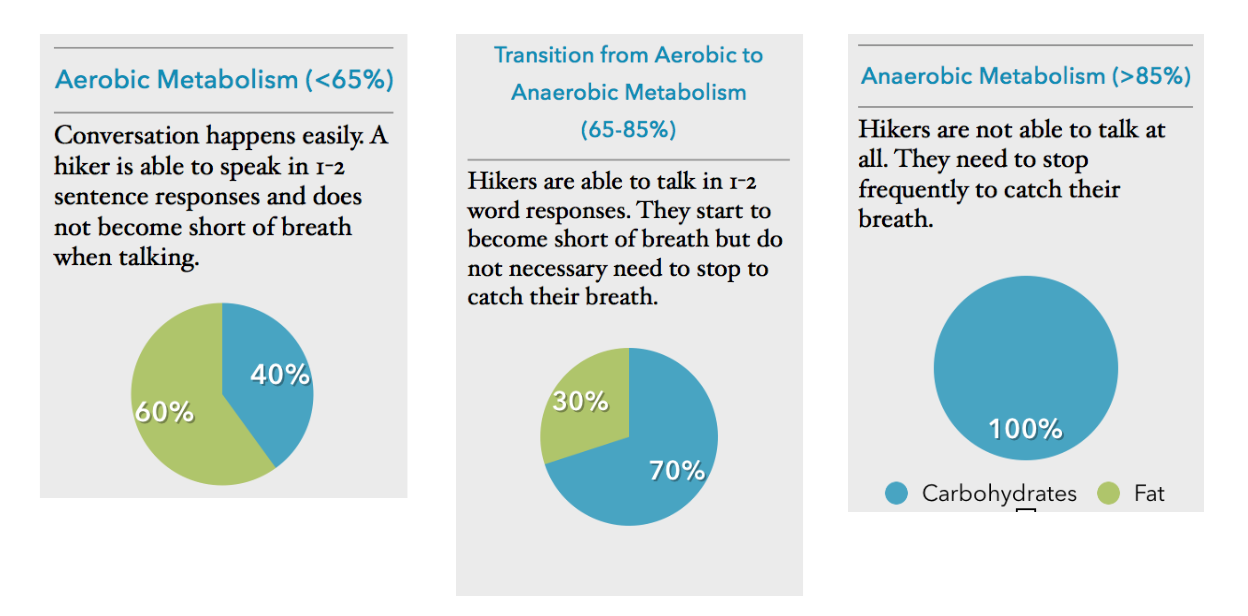
Aerobic (meaning with oxygen) metabolism happens when an athlete is below 65% of their maximum oxygen consumption limit. During this time, the body can get an ample amount of oxygen to your muscles. This type of metabolism happens during a slow, steady hiking pace and when a hiker is not experiencing shortness of breathe. During Aerobic exercise, fat and carbs are the main sources of energy.
“Anaerobic” (meaning without oxygen) metabolism takes place when the amount of oxygen breathed in cannot keep up with the rate of metabolism. The body begins to switch to anaerobic metabolism when a hiker reaches 65% or above their maximum oxygen consumption. In other words, the faster someone hikes and the harder they breath, the more likely they are to be undergoing anaerobic metabolism. The amount of oxygen needed to metabolize fats cannot get to your muscles quickly enough. During Anaerobic metabolism, carbs become the major energy source since they do not require as much (or any) oxygen to metabolize.
Unfortunately, the most accurate way to test the different consumption levels of oxygen must be done in a controlled lab. However, estimations of oxygen limits can be made using the heart rate. It is important to keep in mind that oxygen thresholds change after training. In order to get the best estimate, it is recommended to measure the the heart rate once a hiker is fully trained or has been hiking for a few weeks. If a hiker is untrained at the time of the assessment, the heart rate can still be taken and predictions of oxygen consumption thresholds can still be made. The margin of error will just be a little larger since estimations are made from population averages and not an individual's specific needs.
The most practical way for a hiker to estimate oxygen usage is the “talk test”. The “talk test” is an easy test to measure maximum oxygen while hiking. It is not as accurate as measuring heart rate, but more practical. The amount that you are able to talk while hiking can be an accurate indicator of the type of metabolism that your body is undergoing. Refer to the graphs below to assess metabolism of each macronutrient.
Tips for Fueling Your Body Correctly
- It is best to keep a steady pace when hiking. Aim to be able to talk in 1-2 sentence or 1-2 word responses.
- Its natural for muscles to be sore after hiking but continued soreness, over several days, can mean that your muscles are not getting the correct fuel to function. Muscle soreness is often caused from lactic acid build up from Anaerobic metabolism. To prevent lactic acid build up, consume more carbohydrates and hike at a slower pace until your muscles can adapt.
- Eat a variety of fats, carbohydrates, and protein at every meal.
- Aim to eat a snack at every break to make sure you always have fuel readily available for your body to use.
- Try to eat dinner within 30 minutes of stopping for the day. Since your heart rate is still increased from hiking, increased blood flow with help your muscled and liver utilize nutrients more efficiently.
- Mix water with gatorade powder to help get extra calories from carbohydrates and important electrolytes.